

Let’s take a moment to consider trees. Not in a “hug a tree” way, although nothing wrong with that either in a real and practical way. If you have ever seen a big, old oak in someone’s yard and thought, Wow, that’s one healthy tree, then someone has been taking care of it. And part of that care?
Trimming is one of the most unrecognized, but the most important things you can do for the health of your tree.
Now, the thing is, a lot of people think that trimming is just about looks. You know, keeping the branches tidy, making sure they don’t get too close to the house, and making sure the neighbours won’t complain if limbs extend over the fence. And trimming does do all of those things. But trimming is much more than a cosmetic adjustment – it’s a sort of medicine for your trees. If done properly, it can add literally years and decades to their life. If done improperly, let’s just say there is a chance that you can do more harm than good.
Let’s get right into it and unpack this relationship with trimming and tree health. I am going to keep it straightforward, like we are just chatting about our yards, because that is what this is about: maintaining and keeping your trees healthy, strong, and safe.
Why Trees Are Even in Need of Trimming in the First Place
Here’s the deal: trees in nature don’t get trimmed. Trees just fall, break, bend, and grow however they want, and that’s totally acceptable if they are in the forest! In the forest, trees shed whatever branches whenever they want, and it doesn’t matter how much it costs – nature cleans up any mess.
Now, in our yards – it’s a different deal! Trees are generally situated so close to buildings, driveways, fences, and powerlines that they have to be trimmed to avoid unexpected damage and liability. If we don’t trim trees, we risk having a heavy limb resting on the roof, branches touching the siding, or simply deadwood waiting to fall during a windstorm. Trimming keeps trees safe for us, but it also keeps trees safe from themselves.
When a tree has too many branches, especially with multiple branches crossing over one another, it can cause stress on the tree. Too much shade inside the canopy, too little airflow through the canopy, and you’ve got the perfect conditions for pests, disease, and slow growth. Trimming is a way of allowing your tree to breathe.
The Health Benefits of Trimming
So, let’s get down to the nitty-gritty. What does trimming do for a tree’s health?
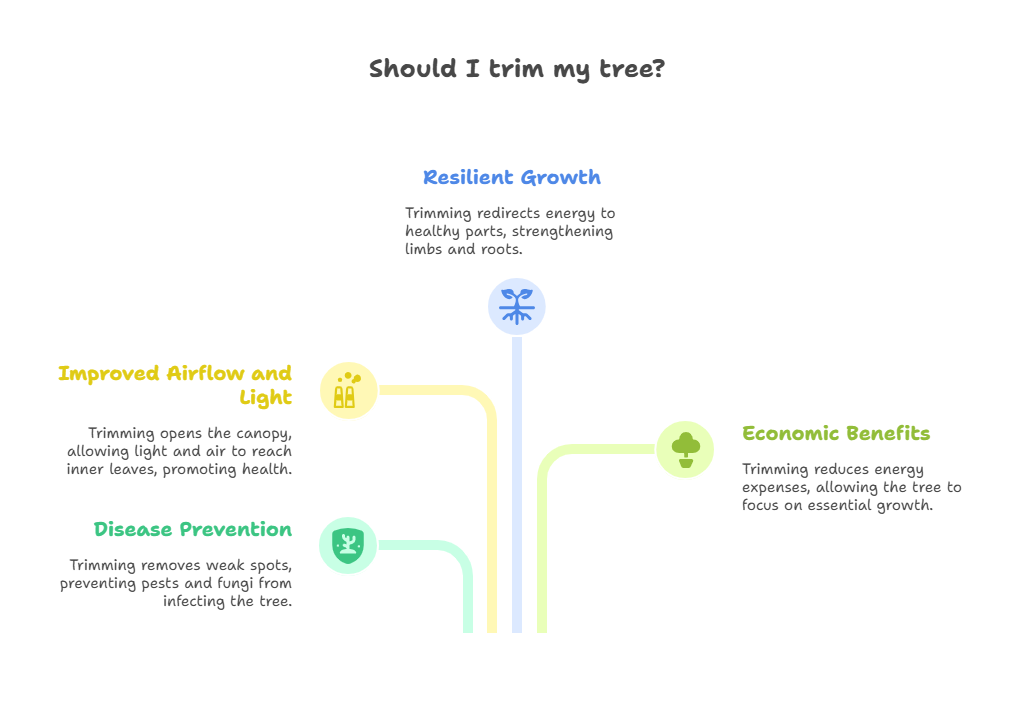
1. Disease prevention
You could consider trimming to be like removing a splinter before it gets infected. Dead or diseased branches are weak spots in a tree, and they invite pests, fungi, and bacteria into the tree. If you let dead or diseased branches remain, the problem only worsens and spreads. By trimming them out, you inhibit the infection from continuing.
👉 Read more: Common tree diseases and how trimming helps prevent them
2. Better airflow and light
Trees need light and air. They are alive after all. When branches crowd one another, the insides of the canopy do not get any light, and therefore, the area becomes dark and damp. This is pretty much as good as it gets for fungus and insects. Trimming, or branch thinning, will open the canopy up, allowing light to penetrate the inner leaves, along with allowing the air to flow. The result of this work is a tree that is stronger and healthier, and helps keep things in balance.
3. Promoting resilient growth
Here’s some science: when you prune a tree, you redirect the tree’s energy. The tree doesn’t waste time and materials developing weak or unnecessary branches; it focuses on growing the healthy parts. This means stronger limbs, a sturdy trunk, and a root system able to withstand storms.
👉 Helpful guide: The importance of tree health pruning
4. Awesome tree economics
A tree is like a budget. A tree with too many branches has too many “expenses.” Those leaves need water, nutrients, and structure. When the tree has too much going on, it can’t put the energy towards the big-ticket items. When you trim the tree, you lessen the load.
👉 Learn more about regular trimming and long-term tree health
The tree can now put that energy where it really matters.
The Perils of Skipping Trimming
Alright, let’s turn this upside down. What happens when no tree trimming gets done?
- Dead wood becomes dangerous. A storm rolls in, and boom, a brittle limb falls on your car, fence, or worse, your roof.
- Pests come in. Dead wood is an invitation for termites, beetles, and a list of other creatures you don’t want to deal with.
- Over time, trees weaken. Excessive shade within the canopy leads to thinning leaves, poor circulation, and overall decline.
- Homeowners’ yards become unsafe. Overgrown trees can obscure visibility, interfere with power lines, and become a liability if they fall.
Sure, you are probably saving a few bucks now by skipping trimming, but you will almost always, in the long run, pay more.
Timing Is Important: When to Trim
One question I get all the time is: When is the best time to trim trees?
Most trees respond better to trimming when they are dormant, i.e., late winter or very early spring. Why? Because the tree is not actively growing, the trimming will be less stressful to the tree. Also, since it is cold, pests and fungi are generally not active, so when we trim the tree is less likely to get infected through the wound.
That said, dead or hazardous limbs should come off at any time. And if you have a limb on the verge of falling, don’t worry about it being the wrong season. Safety first.
The Correct Way to Prune
This is where people seem to mess up. Pruning isn’t just cutting branches off. There is an art and science to it.
- Cut at the right location – just outside of the branch collar.
- Don’t top the tree – tree topping is harmful.
- Balance the canopy – keep even distribution.
- Less is more – never remove more than 25% of a canopy in one season.
Trimming Trees for Different Types
Not all trees are the same, and knowing what type you’re trimming makes a big difference:
- Fruit trees: trimming promotes better fruit production.
- Evergreens require less trimming, but dead or overcrowded branches should go.
- Shade trees: focus on structure and canopy thinning.

Professional vs DIY
To be very clear, you can trim small branches yourself if you feel safe. But anything involving chainsaws, large branches, or powerlines should be left to profesional tree trimming services.
Professional arborists have the tools and training to keep both the tree and you safe.
The Long-Term Benefits
This is my favourite part of all: When you prune your trees consistently, you are not preventing problems; you are investing for the future. Healthy, well-maintained trees:
- Increase property value
- Provide better shade (savings on cooling costs in the summer!)
- Last longer and get stronger
- Look better
👉 Check out tree removal services in Kansas City if you’re dealing with unsafe or dying trees.
A Final Comment
To bring it all together, trimming is not just about looking good. It is not just about keeping your yard immaculate (though that is a nice by-product). Trimming is about providing your trees with an opportunity for a long and healthy life.
Ultimately, the link between trimming trees and tree health is simple yet extremely powerful; when you trim properly, you are not removing something from the tree, but rather allowing it to flourish by improving the opportunity for strength, vitality, and eventual lushness.
So the next time you’re standing in your yard looking up into the trees, remember that with just a little care and a little trimming, you are not just maintaining your trees, you are protecting the core of your landscape.
Jose Maldonado
Owner, Omar Tree Service LLC
Located: 3020 Bellaire Ave, Kansas City, MO
Phone: +1 (816) 694-6352
READ MORE